Someone honked at me once for waiting at a red light. I wasn't doing anything wrong. Or was I?
That moment made me ask:does Georgia law actually require you to stop before turning right on a red light?
Most drivers think they know the answer but don't know the full rule. I went through Georgia Code §§ 40-6-20 and 40-6-21 and the Georgia Department of Driver Services (DDS) Driver's Manual so you don't have to guess anymore.
By the end of this article, you'll understand the exact law, what "complete stop" legally means, every exception, and what happens if you get it wrong.
Disclaimer:This article is for informational purposes only and is based on Georgia Code § 40-6-20, Georgia Code § 40-6-21, and the Georgia Department of Driver Services (DDS) Driver's Manual. Traffic laws can change, and local ordinances may impose additional restrictions. Consult official state resources or a qualified attorney if you need legal guidance specific to your situation.
Does Georgia Law Require You to Stop Before Turning Right on a Red Light?
Yes. Georgia law requires a complete stop before turning right on a red light. Not a slow roll. Not a brief pause. A full, complete stop where your wheels stop moving entirely.
Under Georgia Code § 40-6-21, when facing a steady circular red signal, you must stop at the clearly marked stop line or, if there is no stop line, before the crosswalk, or if there is no crosswalk, before entering the intersection itself.
Only after that complete stop may you turn right, provided no sign prohibits it and it is safe to do so.
The stop is not optional. It is the law.
What Do Georgia Code §§ 40-6-20 and 40-6-21 Actually Say?
Most articles mention one of these sections and move on. That is not enough. Both sections work together to define what Georgia requires at a red light.
Georgia Code § 40-6-20 is the foundational rule: every driver must obey the instructions of an official traffic-control device placed in accordance with state law, unless directed otherwise by a police officer.
Violating this subsection is a misdemeanor.
The law also establishes that disregarding any official traffic-control device is prima-facie evidence of a violation, meaning if you disobey a signal, the law presumes you broke it.
Georgia Code § 40-6-21 is titled "Meaning of Traffic Signals" and is where the specifics are spelled out.
Here is what it says about a steady circular red signal, in plain English:
Step 1: Stop.
Traffic facing a steady circular red signal must stop at the clearly marked stop line. If there is no stop line, stop before the crosswalk on the near side of the intersection.
If there is no crosswalk, stop before entering the intersection. You must remain standing until an indication to proceed is shown, except as provided in the limited exceptions below.
Step 2: Right Turn Is Permitted, With Conditions.
After stopping as required, vehicular traffic facing a steady circular red signal may cautiously enter the intersection to make a right turn.
You must stop and remain stopped to allow any pedestrian to cross within a crosswalk when the pedestrian is on the half of the roadway you are traveling or turning onto, or approaching within one lane of that half.
Step 3: Right Turn Is Prohibited in Certain Cases.
You cannot make a right turn against a steady circular red signal at any intersection where a sign is posted prohibiting it.
Step 4: Left Turn On Red Is Narrowly Permitted.
After stopping, traffic may make a left turn from the left-hand lane of a one-way street onto a one-way street where traffic moves toward the driver's left, but only after stopping, yielding to all traffic, and remaining stopped for pedestrians.
What the law calls a "steady circular red signal" is the round red light most drivers recognize.
The word "circular" matters because Georgia law distinguishes it from a red arrow signal, which carries entirely different requirements.
Where Exactly Must You Stop?
The law specifies three stopping positions in order:
- At the clearly marked stop line, the white bar painted across your lane before the intersection.
- If no stop line exists, before entering the crosswalk on the near side of the intersection.
- If no crosswalk exists, before entering the intersection itself.
Stopping past the stop line or inside the crosswalk is not a legal stop. Your vehicle must be behind the applicable boundary.
What Counts as a Complete Stop in Georgia?
This is one of the most searched follow-up questions about this topic, and for good reason.
Under Georgia law, a complete stop means your wheels must fully cease all forward motion. The vehicle must stop moving entirely.
Rolling Stop vs. Complete Stop
A rolling stop, sometimes called a "California stop", is when a driver slows down significantly but does not come to a full stop. The wheels keep rolling, even slowly.
That is illegal in Georgia.
Georgia appellate courts have held that a traffic violation under the Uniform Rules of the Road constitutes negligence as a matter of law:Mathis v. Mangum, 166 Ga. App. 415 (1983) is one example cited in the annotated code.
Slowing to 2 miles per hour and proceeding still counts as a moving violation.
Officers frequently issue citations for rolling stops, particularly at busy intersections and pedestrian-heavy areas.
From a patrol car positioned near or at an intersection, it is straightforward to observe that a vehicle's wheels did not fully stop before a right turn, the vehicle's suspension does not compress and rebound as it would during a true stop.
More importantly, if a rolling stop leads to a collision with a pedestrian or another vehicle, Georgia appellate courts have consistently held that violating the Uniform Rules of the Road, which include §§ 40-6-20 and 40-6-21, gives rise to a claim of negligence per se.
This means your failure to comply with the law is treated as negligent conduct as a matter of law, though the plaintiff must still prove that the violation was the proximate cause of the injury and that the violation was not excused.
The difference between a complete stop and a rolling stop could determine the outcome of a civil liability case.
Red Arrow vs. Solid Red Light
Many drivers confuse these two signals. They look similar but carry completely different legal requirements.
| Signal | Can You Turn Right? |
| Steady circular red light | Yes, after a complete stop, if safe and no sign prohibits it |
| Steady red arrow | No, wait for a green indication |
| Flashing red light | Stop completely, then proceed if safe (treat as a stop sign) |
| Flashing red arrow | Yes, after a complete stop, yielding to all traffic and pedestrians |
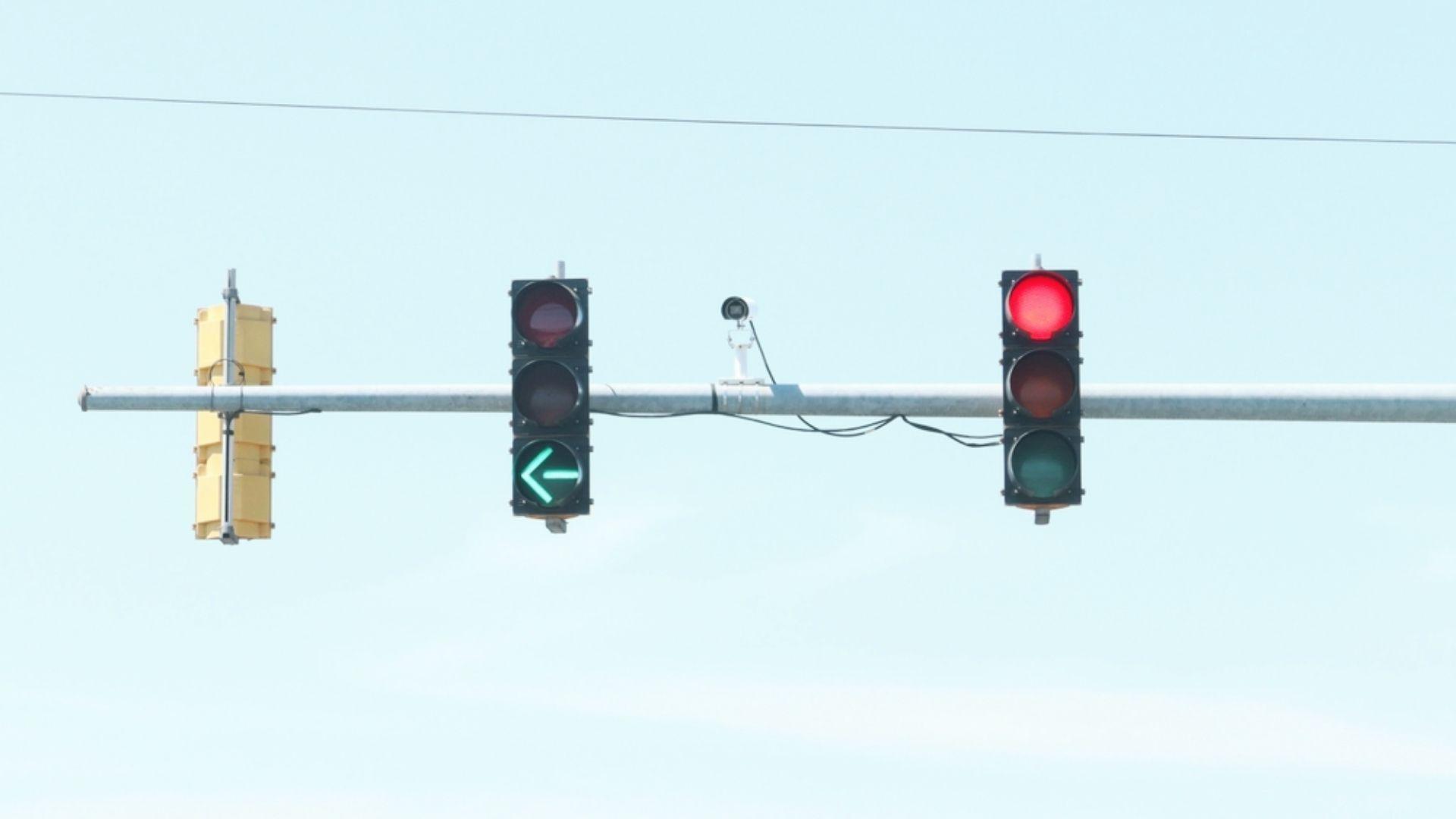
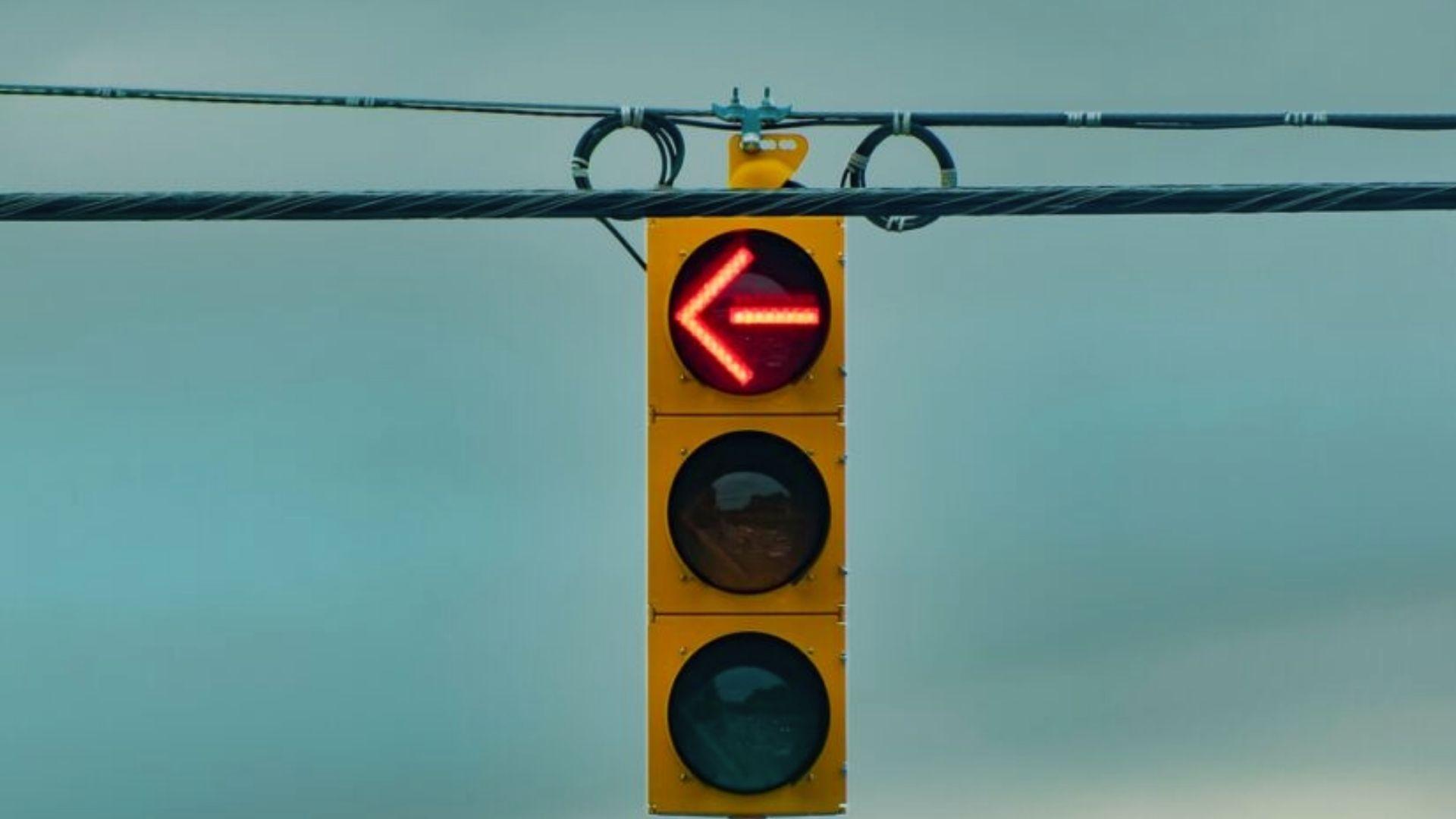
Under Georgia Code § 40-6-21, a steady red arrow means no turn in the direction of the arrow at all, not even after a full stop. You must wait for a green signal or green arrow.
A flashing red light, by contrast, is treated like a stop sign under the Georgia DDS Driver's Manual. Stop completely, yield to all traffic and pedestrians, and proceed when safe.
If you are unsure which signal is showing, the shape tells you:circular means the round red light, arrow means the arrow-shaped signal. Do not treat them the same way.
When You Are Allowed to Turn Right on Red
You can turn right on red in Georgia when all of the following are true:
- You came to a complete stop at the stop line, crosswalk edge, or before the intersection.
- No "No Turn on Red" sign is posted at the intersection.
- The signal showing is a steady circular red light, not a red arrow.
- There is a safe gap in oncoming traffic.
- You have yielded to all pedestrians in or approaching the crosswalk.
- You have yielded to all vehicles already moving through the intersection.
Every condition must be met. Satisfying most of them is not sufficient.
When Turning Right on Red Is NOT Allowed
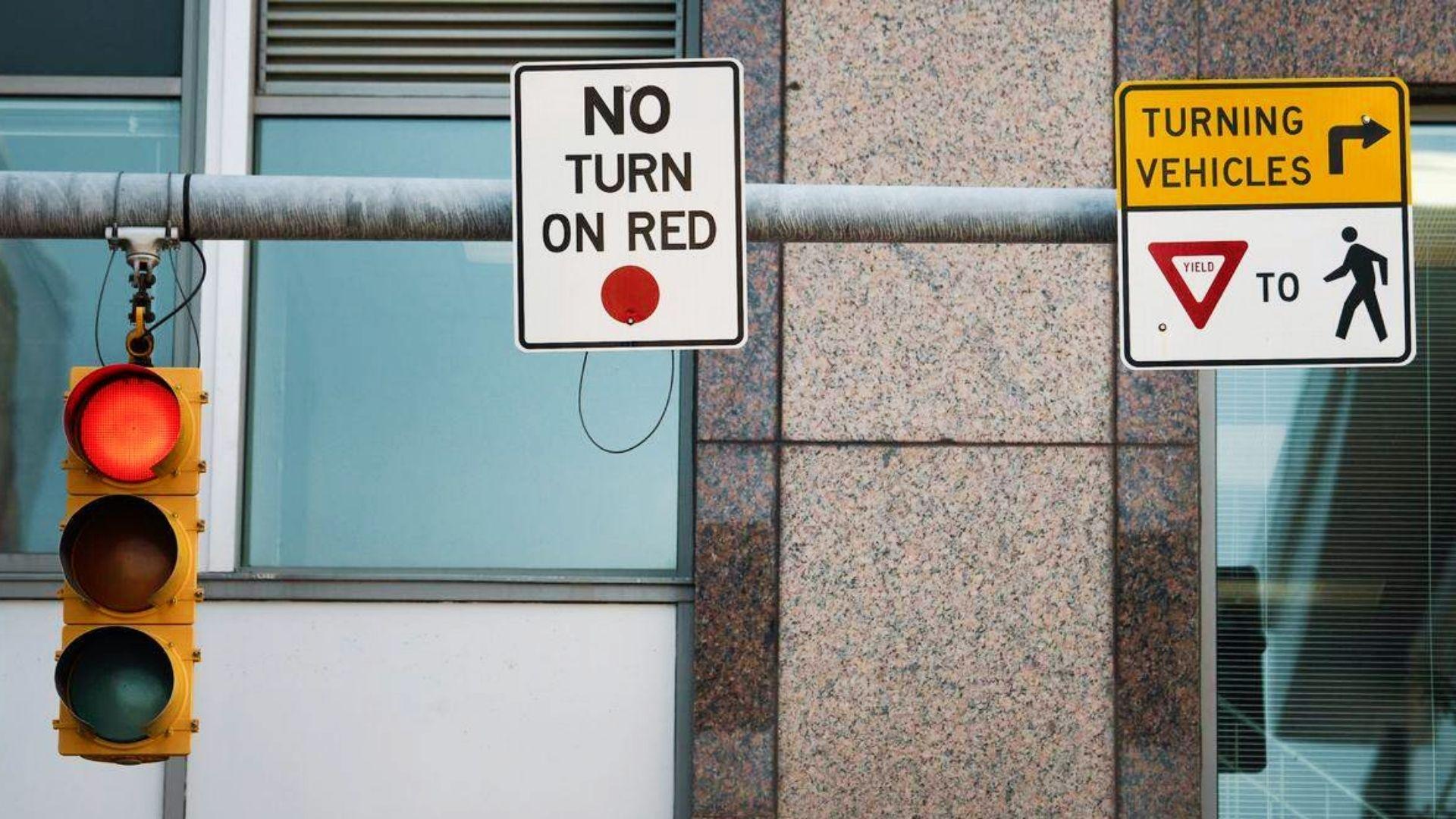
"No Turn on Red" sign posted. No right turn is permitted regardless of traffic conditions. There is no exception.
A red arrow means no turn. You must wait for a green indication, even after a full stop.
If a pedestrian is crossing on the half of the roadway you are traveling or turning onto, or approaching within one lane of it, you must remain stopped until they have cleared your path.
Under Georgia Code § 40-6-20, a police officer's directions override any traffic signal or sign. Follow the officer, not the light. Some Georgia cities impose additional restrictions.
Certain areas of Atlanta, particularly downtown, midtown, and Castleberry Hill have seen active discussion about banning right turns on red entirely in high-pedestrian zones.
Always watch for local signage that may be stricter than state law.
Pay close attention to all posted traffic-control devices in school zones. Violations there frequently carry elevated penalties.
Temporary signals in construction zones carry the same legal weight as permanent ones.
Yield to all highway maintenance vehicles and workers. If a flashing red is showing, treat it as a stop sign.
If an emergency vehicle is approaching with lights and sirens active, pull to the right side of the road and stop. Do not block the intersection. Do not proceed with your turn until the vehicle has passed.
Common Right-on-Red Situations Explained
Empty intersection at night. The law does not change because the road looks clear. You still must come to a complete stop. "Nobody was coming" is not a legal defense.
Driver behind you honking. The person honking is wrong, not you. Another driver's impatience does not change your legal obligation or create a right to skip the stop.
Dedicated right-turn lane. A dedicated right-turn lane does not eliminate the requirement to stop at a red light. Stop at the stop line in that lane, then proceed only after a complete stop when safe.
No crosswalk markings. The absence of painted lines does not remove the stop requirement. Georgia Code § 40-6-21 still requires you to stop before entering the intersection itself.
Pedestrians waiting at the curb but not yet crossing. If pedestrians are standing on the sidewalk but have not stepped into the roadway, you may proceed after your complete stop, but watch carefully in case they step off the curb as you begin to turn.
Cyclist approaching. Cyclists in the roadway have the same right-of-way protections as vehicles. If a cyclist is traveling through the intersection in the lane you are turning into, yield before completing your turn.
Heavy traffic with no safe gap. There is no time limit on how long you may wait at a red light before turning. If no safe gap exists, remain stopped.
Light turns green while you are waiting. If the signal turns green before you turn, proceed on the green as normal. You now have the standard right of way.
Turning onto a highway entrance or high-speed road. A gap that is adequate on a surface street may not be sufficient at highway speeds. When in doubt, wait.
Large trucks making right turns. Commercial vehicles may need to swing wide. If a truck to your left is signaling a right turn, do not attempt to pass it on the right. The truck may legally occupy your lane during the maneuver.
Left Turn on Red in Georgia
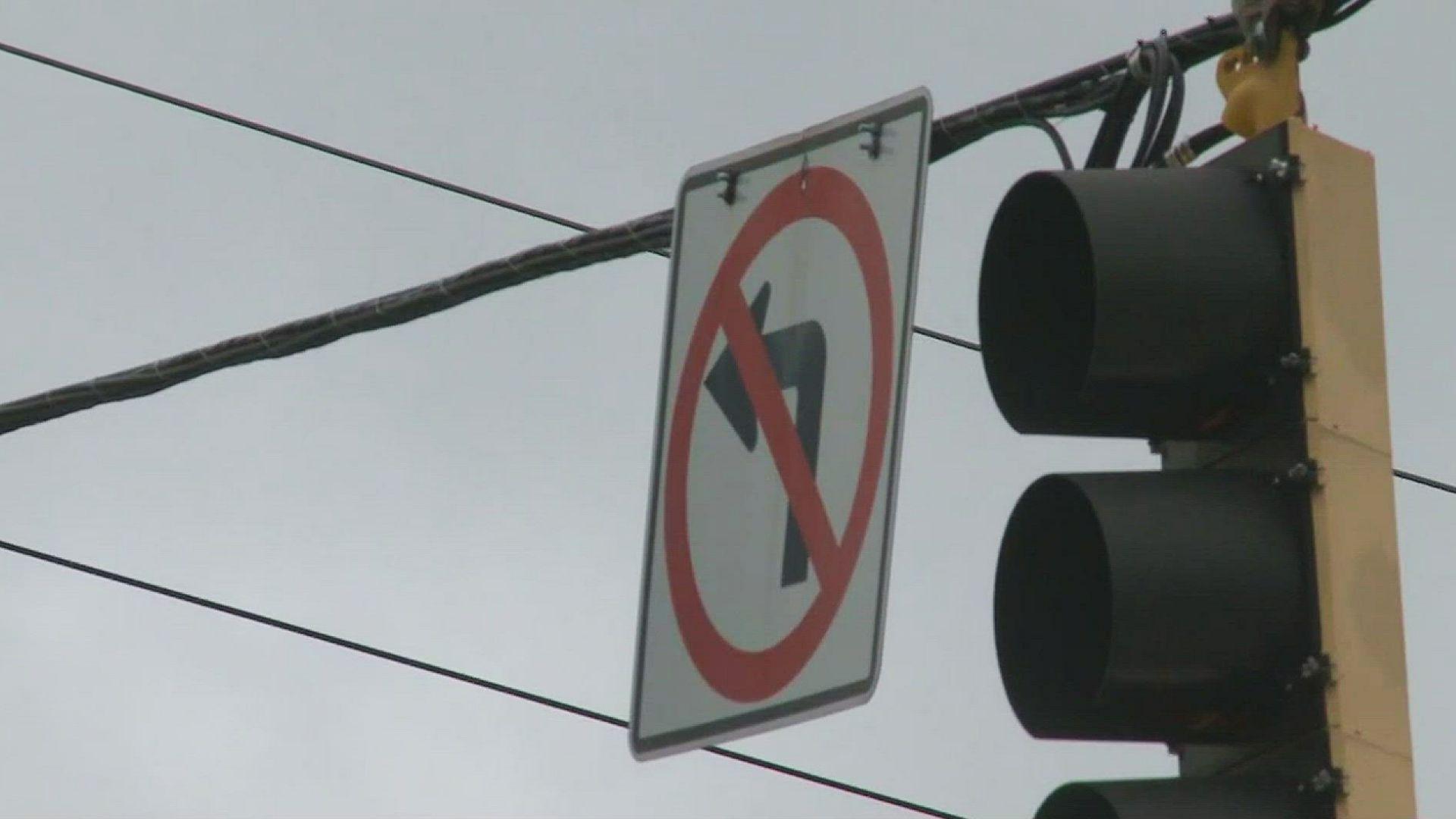
Georgia law does allow a left turn on red but only in one specific situation.
You may turn left on red only when turning from the left-hand lane of a one-way street onto a one-way street where traffic moves toward the driver's left.
Even then, you must make a complete stop first, yield to all traffic, and remain stopped for pedestrians.
This does not apply at regular two-way intersections. Both the street you are leaving and the street you are entering must be one-way. When in doubt, wait for the green.
Every Major Exception to Know
These exceptions can save the day:
Flashing red light:Treat as a stop sign per the Georgia DDS Driver's Manual. Come to a complete stop and proceed only when safe, yielding to all traffic and pedestrians.
Flashing yellow light:Slow down and proceed with caution. No stop is required unless traffic conditions make it necessary.
Malfunctioning traffic signal:If a signal is not functioning at all, treat the intersection as a four-way stop. Come to a complete stop and yield as you would at a stop sign.
Temporary construction signals:Full legal force applies. Obey them as you would any permanent traffic-control device.
School zones:Reduced speed limits and additional restrictions apply. Pay close attention to all posted signage and yield to pedestrians, particularly during school arrival and dismissal hours.
Emergency vehicles: Pull to the right and stop when an emergency vehicle approaches with lights and sirens. Resume only after it has passed.
Police officer directing traffic:A police officer's directions override any signal or sign. Follow the officer.
Enforcement: What Actually Happens
Understanding this can remove a lot of confusion:
How Officers Detect a Rolling Stop
A trained officer observing an intersection can determine whether a vehicle's wheels fully stopped.
When a vehicle makes a true stop, its suspension compresses slightly and rebounds, a visible physical cue. A vehicle that slows but keeps rolling does not produce that motion.
Officers frequently monitor intersections known for pedestrian activity, high collision rates, or pedestrian fatality history.
In Georgia, school zones, downtown business districts, and intersections near hospitals or university campuses tend to see higher enforcement presence, though departments do not publicly publish specific monitoring lists.
Construction zones and intersections near crosswalks without traffic signals are also common areas where officers position themselves.
Patrol car dashcam footage captured during a traffic stop can also document whether your vehicle stopped fully, and that footage may be reviewable if you contest the citation in traffic court.
Red-Light Camera Enforcement
Georgia law permits automated traffic-control signal monitoring devices at intersections. These systems use sensors in the pavement that trigger when a vehicle crosses the stop line while the light is red.
The camera captures images of the vehicle and license plate.
Under Georgia Code § 40-6-20(f), the jurisdiction must mail notice of the violation to the registered owner within ten days, including the date, time, location, and a copy of the recorded images.
A red-light camera citation is a civil violation, not a misdemeanor.
The maximum fine is $70, and under Georgia Code § 40-6-20(f)(4), it does not add points to your driving record and is not considered a conviction.
However, if an officer independently issues a misdemeanor citation for the same violation, the city cannot also impose the camera civil penalty.
The Role of Dashcams in Disputes
If you believe a citation was issued in error, for example, you made a complete stop but the officer's view was obstructed, dashcam footage can be significant evidence.
According to Georgia traffic attorneys, dashcam video is one of the strongest tools available for contesting a traffic citation, because it provides a timestamp-verified, unbiased record of your vehicle's movement at the moment in question.
If you have dashcam footage relevant to a citation, preserve it immediately. Courts and insurance companies both accept properly authenticated video evidence.
If you do not have dashcam footage, an attorney may be able to request intersection surveillance footage, though availability varies by jurisdiction and camera coverage.
Conversely, dashcam footage can work against you.
If you roll through an intersection and the footage shows it clearly, that evidence can be used by the opposing side in a civil case. The camera does not take sides.
Points, Fines, and Insurance
A misdemeanor conviction for failing to stop at a red light adds 3 demerit points to your license under Georgia's point system administered by the Department of Driver Services (DDS).
Accumulating 15 points within any 24-month period triggers a license suspension.
Fines for a misdemeanor conviction generally range from $200 to $250 depending on the county, with court costs added. The statutory maximum for a misdemeanor is $1,000.
Points on your record are reported to your insurer, and a moving violation conviction typically results in higher premiums at your next policy renewal.
Liability After a Crash
If a collision occurs because you failed to stop completely, your violation of § 40-6-21 establishes negligence per se under Georgia law.
Georgia appellate courts have held that violations of the Uniform Rules of the Road which include the traffic signal laws, support this doctrine.
It means your conduct is treated as negligent as a matter of law, though the plaintiff must still prove that the violation approximately caused the harm and that no valid excuse applied.
You do not need to have received a citation for this to apply in civil court.
Common Myths About Right Turns on Red
"Nobody was coming, so I didn't need to stop." False. Georgia law requires a complete stop regardless of traffic conditions. The stop precedes your assessment of whether it is safe to go.
"Everyone else rolls through, so it must be okay." False. Common practice is not the same as legal compliance. A rolling stop is illegal regardless of how many other drivers do it.
"A dedicated right-turn lane means I can skip the stop." False. A right-turn lane does not change the signal law. If the light is red, stop at the stop line.
"I paused briefly, which counts as a stop." False. A pause where wheels keep moving is a rolling stop and is a violation under Georgia law.
"The person honking means it's safe to go." False. The driver behind you cannot see what you can see from your position at the intersection. Their honking is not a safety clearance.
"A right turn on red is my right, I don't have to yield." False. A right turn on red is a conditional permission, not a guaranteed right. The moment any required condition is not met, the permission disappears.
Why Drivers Get Confused About Right Turns on Red
Right-on-red rules vary across the country. New York City prohibits right turns on red throughout the city by default unless a sign specifically permits it.
Drivers who recently moved to Georgia from states with more restrictive rules may be uncertain whether the turn is allowed here at all.
Confusing red arrows with circular red lights. Many drivers do not realize these are different signals with entirely different legal requirements. Both are red, but their rules are not the same.
Uncertainty about where to stop. Georgia intersections vary widely.
Some have clearly painted stop lines. Others have no markings at all. Drivers are not always sure where they are supposed to position their vehicle.
Pressure from other drivers. Honking and tailgating at red lights creates real pressure to move before the stop is complete.
Drivers who know the law correctly can find themselves second-guessing it when another driver is impatient.
What To Do If You're Unsure
When in doubt, don't turn.
If you are not certain whether a sign, signal, pedestrian, or cyclist affects your right to turn, wait for the green light.
The law does not penalize you for waiting. It only penalizes you for turning when the conditions are not fully met.
If a driver behind you is honking, stay put. If visibility is limited by a truck or parked vehicle, wait until you can clearly see cross-traffic. If you see a pedestrian near the curb and you are not sure whether they are about to step off, wait.
Waiting a few extra seconds at an intersection is always the safer and legally correct choice when there is any doubt.
Conclusion
The answer to "does Georgia law require you to stop before turning right on a red light?" is yes, a full, complete stop, every single time, regardless of traffic conditions, time of day, or what other drivers around you are doing.
Georgia Code §§ 40-6-20 and 40-6-21 and the Georgia DDS Driver's Manual all say the same thing:stop completely, yield to pedestrians and traffic, and proceed only when you have confirmed it is safe.
I used to rush through intersections without thinking twice. These days, I stop, check, and move only when it's safe.
Three seconds of patience at a red light is a small price compared to the alternative.
Found this helpful? Share it with someone who drives in Georgia and drop a comment below.
Frequently Asked Questions
Does a rolling stop count in Georgia?
No. A rolling stop is illegal. Your wheels must fully cease movement before the stop counts.
What is the fine for running a red light in Georgia?
A misdemeanor citation typically results in fines between $200 and $250, with court costs added. A red-light camera civil penalty is capped at $70 and does not add points to your license.
How many points does a red light violation add in Georgia?
A misdemeanor conviction adds 3 demerit points. A red-light camera civil penalty adds no points.
What happens if I get 15 points on my Georgia license?
The Georgia Department of Driver Services (DDS) will suspend your license if you accumulate 15 points within any 24-month period.
Can a dashcam help me contest a red light ticket in Georgia?
Yes. Dashcam footage is considered strong evidence in Georgia traffic disputes, as it provides a verifiable record of your vehicle's movement at the time of the alleged violation. Preserve the footage immediately and consult an attorney before going to court.